Thought Leadership
The Silent Floor: Using Edge AI to Find Bottlenecks on the Production Line
Most production lines don't die from catastrophic failure. They die from quiet, invisible idle time. Here's why instrumenting the floor — not just the machines — is overdue.
Pulses.aiEditorial5 min read

Most production lines don't die from catastrophic failure. They die from quiet, invisible idle time — the seventy seconds a part sits at a station waiting for an operator who is two metres away on another task; the four minutes a forklift idles next to a pallet because no one upstream signalled it was ready; the eleven seconds, multiplied by ten thousand cycles a day, that nobody noticed because nobody was measuring.
Modern manufacturing has spent twenty years instrumenting the machines. It is now overdue for instrumenting the floor.
What the Machine Data Doesn't Tell You
MES, SCADA, and OEE systems are excellent at telling you what the equipment did. They are silent on what happened between the equipment — the human flow, the asset flow, the bottleneck that formed at the conveyor handoff because two cells were calling for the same operator at the same time. Most plant managers can describe these problems vividly from memory. Very few can pull them up on a screen.
This is the gap Pulses was built to close. Pulses is a Physical Intelligence platform — it observes the physical reality of the floor and converts it into a structured, real-time data stream. The machines tell you their story. Pulses tells you the rest.
The Pulses Architecture on a Factory Floor
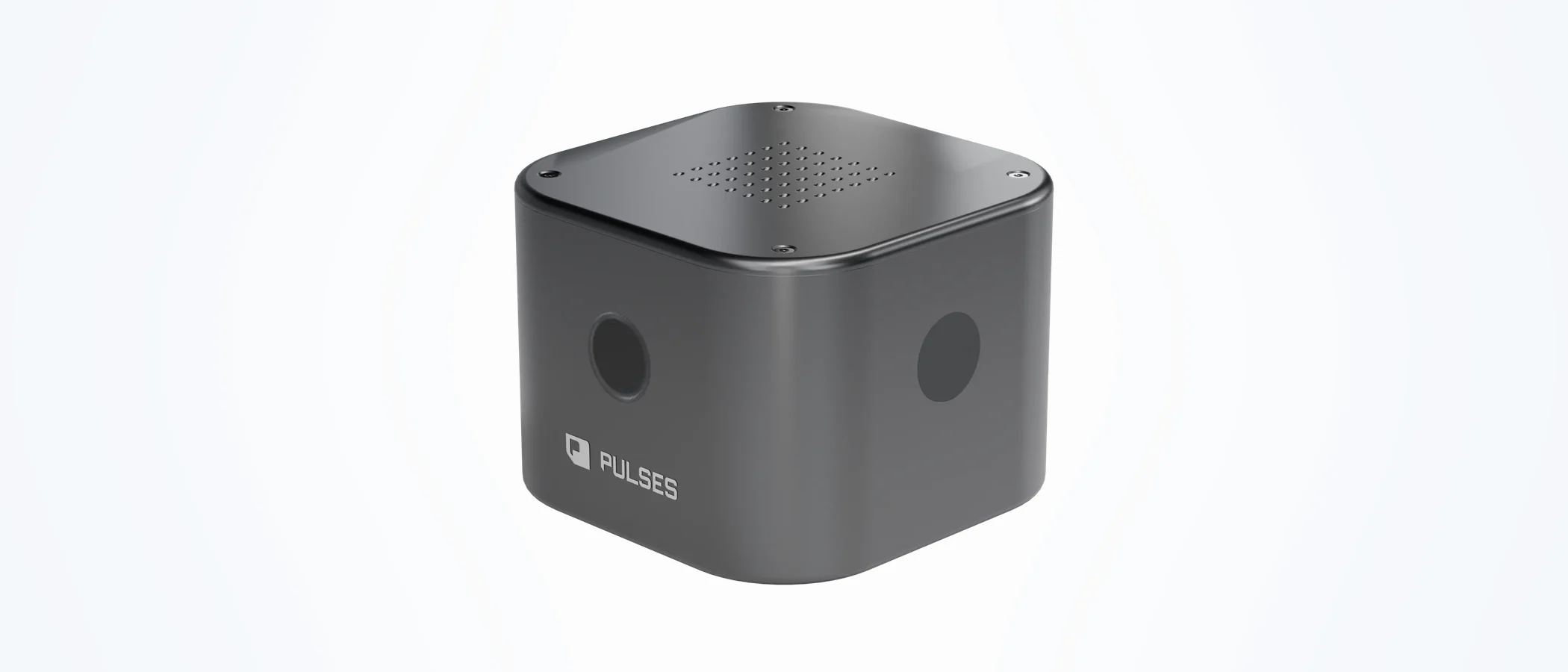
The deployment is straightforward. Pulses Vision Devices — Pulses Vision for indoor cells, Pulses Vision Pro for outdoor yard areas — observe the lines, the laneways, the loading docks, and the staging zones. Pulses OS turns that observation into intelligence, organised into two highly relevant modules:
- Pulses Ops — the flow layer. Throughput by line, by cell, by hour. Cycle-time variance per station. Idle time against expected baselines. Operator-to-station ratios. Forklift and tugger utilization in the laneways. Bay and dock utilization at goods-in and goods-out. SLA alerts the moment a station crosses an idle-time threshold — pushed to the supervisor's screen before the shift lead has even looked up.
- Pulses Compliance — the standards layer. PPE enforcement at zone boundaries. Hygiene rules in food, pharma, and clean-room environments — hairnets, gloves, gowning, hand-wash adherence. Contactless entry at restricted-area kiosks, where it is required. Perimeter integrity for high-value or hazardous zones. Each event is logged, structured and ready for audit.
Pulses OS adapts the language to the use case — "humans" becomes "operators," "vehicles" becomes "forklifts" or "AGVs." Same platform. One codebase. Industry-appropriate wording.
Why Edge AI Is Non-Negotiable in Manufacturing
A factory floor is one of the most demanding environments in enterprise AI. Lighting changes through the shift. Forklifts move at speed. Operators wear similar PPE. Network latency is the enemy — by the time a cloud platform has processed a frame and returned a result, the moment to act on it is already gone.
Pulses processes video on the device, in a hardened housing with no inbound network ports. What leaves is anonymous data, not video.
That edge speed is the difference between a report on yesterday's shift and an alert to the supervisor while the bottleneck is still forming.
Deployment Without Disruption
Manufacturers can't tolerate weeks of production halt for an IT rollout. Pulses doesn't ask for that. The hardware is wall- or rail-mounted in cell-by-cell deployments around scheduled changeovers. The platform is available Cloud, On-Premise, or Hybrid — including fully On-Prem inside the plant's own data centre for environments with strict data-sovereignty or air-gap requirements.
The integration story is mature: Microsoft Azure for cloud orchestration, Microsoft 365 for surfacing alerts inside the tools your operations team already uses, and clean APIs into the MES, ERP, and CMMS layers you've already paid for. You don't replace your stack. You make it see.
What "Better" Looks Like on the Line
When a plant runs Pulses Ops and Pulses Compliance together, hidden idle time becomes a managed metric. Bottlenecks show up while they form. PPE checks move from a weekly walk-through to a live signal. Audit prep starts from evidence already collected, and supervisors deal with small fires while they are small.
The factory gets quieter. The line keeps moving.
Pulses.ai is the silent operating system that makes the modern plant visible to itself.
Ready to begin?
Curious what your floor actually looks like in motion? Book a demo.
Related Articles
-
 Industry
 From Queues to Citizen Experience: How Physical Intelligence Is Reshaping the Public Service Center
5 min read -
 Industry
 Footfall Is a Vanity Metric. Unique Visitors Are the Truth.
6 min read -
 Industry
 Live Data from Load-In Day: Why Event Operators Are Replacing Clipboards with Physical Intelligence
5 min read